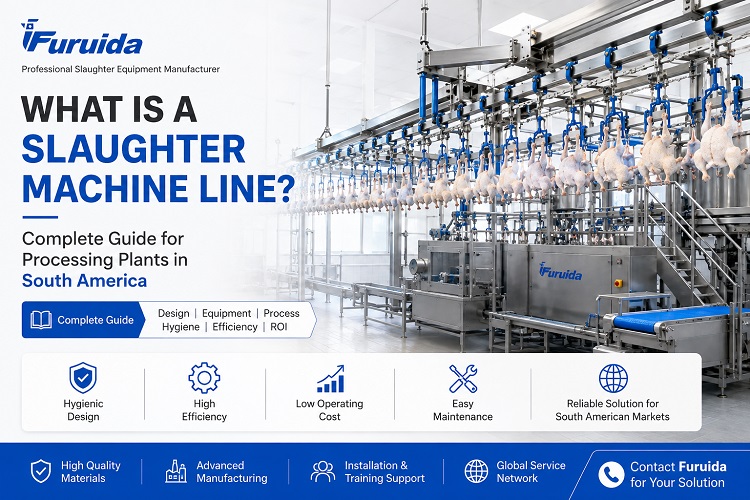
What Is a Slaughter Machine Line? Complete Guide for Processing Plants in South America
South America’s meat processing industry is growing fast. Demand for poultry, beef, pork, and lamb is driving modernization of plants. Manual processing is no longer able to meet today’s production goals. That’s why automation is becoming critical across the region. A slaughter machine line helps plants process animals faster, safer, and more hygienically. It helps to minimize human effort and ensures uniformity in all batches. This guide explains what a slaughter machine line is and how it works. You will also discover how to select the appropriate one for your processing plant.
What Is a Slaughter Machine Line?
Definition and Purpose
A slaughter machine line is a connected system of equipment. It moves animals through every phase of processing, from stunning to final inspection. Manual handling is minimized, as most steps happen along one continuous line. This minimizes the handling time and ensures that the process is uniform throughout. The purpose is straightforward: it turns a complex and labor-intensive task into a simple, repeatable process. All animals follow the same protocol.
Why Processing Plants Use Complete Slaughter Lines
Integrated systems can increase productivity in ways that manual systems can’t. Machines work at a steady pace without fatigue or slowdowns. Hygiene is also greatly enhanced. Automated equipment minimizes direct human contact with the carcasses, thus reducing the risk of contamination. Consistency is another significant benefit. All products are processed consistently in size, quality, and preparation. This matters greatly for plants that export into strict international markets.
How Does a Slaughter Machine Line Work?
Animal Handling, Stunning, and Bleeding
The first is to handle the animals carefully. Less stress results in better meat quality later on. Next comes stunning. This process quickly and humanely renders the animal unconscious while meeting animal welfare standards. The animal is then moved to the next stage using conveyors. The animals walk down a controlled line with proper drainage of the blood. This step is not only for safety, but also to help preserve shelf life.
Dressing, evisceration, and carcass processing
When the bleeding has ended, the dressing procedure starts. For poultry, this means removing the feathers. For livestock, it means the skinning or dehairing of stock. Evisceration follows. Internal organs are carefully removed, avoiding the contamination of meat. This one is particularly important when it comes to food safety. Then the carcass is taken to further processing. These can include splitting, trimming, or portioning, depending on the animal and plant needs.
Washing, Chilling, and Inspection.
Once processed, the carcasses are thoroughly washed. This eliminates the residue and lowers bacteria levels. Chilling comes next. Rapid cooling helps reduce bacterial growth, providing food quality during storage and transportation. Last but not least, the inspection of all carcasses is carried out to ensure safety and quality. The only products approved then proceed to packaging.
Key Equipment in a Slaughter Machine Line
Primary Processing Equipment
To produce a full line, certain major machines are needed. They have their own role to play in the process.
Common equipment includes:
- Stunning equipment for humane and controlled processing.
- Uniform and hygienic blood draining with bleeding conveyors.
- Scalding or skinning equipment appropriate for various animal species.
- Efficient dressing machines – dehairing and defeathering.
- Evisceration systems for organ removal with safety and accuracy.
The machines are the primary equipment for slaughter lines, such as poultry lines, cattle lines, and pig lines.
Conveying, Cleaning, and Chilling Systems
Everything runs smoothly with the help of supporting equipment. Conveyor systems enable products to be moved efficiently from one station to another, with no manual lifting involved. The process of cleaning is provided with maintenance of hygiene. The risk of contamination is minimized during the automatic washing process. Chilling systems are employed to keep the quality of products after processing. This equipment ensures the overall efficiency and safety of the slaughterhouse operations.
Benefits of an Automated Slaughter Machine Line
Higher Productivity and Better Hygiene
Automation greatly boosts processing capacity. Higher numbers of animals per hour can be accommodated in plants without affecting quality. Sanitation also improves. Reduced manual handling lowers the risk of contamination and produces a cleaner end product. It also ensures uniformity of product quality. Every batch is treated in exactly the same, repeatable way.
Lower Operating Costs and Improved Compliance
Automated lines require the use of less manpower. This translates into lower processing plant operating costs in the long term. The safety of workers is enhanced, too. The most physically demanding and hazardous tasks are performed by machines. Compliance is also facilitated. The contemporary meat processing machinery has been designed to meet the food safety standards, especially for those plants that export their products.
How to Choose the Right Slaughter Machine Line for Your Plant
Capacity, Animal Type, and Automation Level
The first step is to determine your capacity needs. Small-scale operations have requirements different from large-scale operations. Think about what type of animal is being processed. Specialized equipment is required for each poultry, cattle, pig, sheep, and goat line. Take into account the level of automation usage as well. Certain plants require fully automated systems, while others will benefit from semi-automated systems.
Quality equipment and after-sales support.
Quality of equipment is directly related to durability and performance. Select a slaughter equipment manufacturer with a good reputation and quality products. The after-sales support is important as well. Look for manufacturers who offer training, spare parts, and quick technical support. This combination ensures that your food processing devices will last for years.
Conclusion
The right slaughter machine line can change the way a processing plant works. It enhances productivity, boosts hygiene, and ensures uniformity of product in every batch. Selecting equipment that is appropriate to your capacity, animal type, and automation requirements is good for the long-term growth of your business. The right setup today prepares your plant for tomorrow’s needs.
Looking for a partner to cater to the specific requirements of South American meat processing companies? Nanjing Furuida Equipment Co., Ltd. provides high-quality and customized poultry and livestock slaughter machine lines with reliable performance. Nanjing Furuida Equipment Co., Ltd. is renowned for its expertise in manufacturing and reliable after-sales service, supporting processing plants throughout South America in maximizing efficiency and achieving current food safety standards.
FAQs
What is a slaughter machine line?
A slaughter machine line is a combined set of equipment handling the animals from stunning to final inspection. It integrates several stages into a single seamless automated process, resulting in greater efficiency, cleanliness, and uniformity than manual operations.
Which animals can be processed on a slaughter machine line?
Slaughter machine lines can be used for poultry, cattle, pigs, sheep, and goats. The equipment depends on the type of animal, and for defeathering, dehairing, or skinning, specialized equipment can be used to suit processing requirements.
How do I choose the right slaughter machine line?
Take into account your production capacity, animal type, and the level of automation you want in your production. Consider the quality of the manufacturer’s equipment and service as well; good service will keep your line running smoothly over time.
What are the benefits of an automated slaughter machine line?
Advantages include increased productivity, better hygiene, uniform product quality, reduced labor expenses, improved safety of workers, and simplified compliance with food safety legislation, particularly for plants that process food for export.