
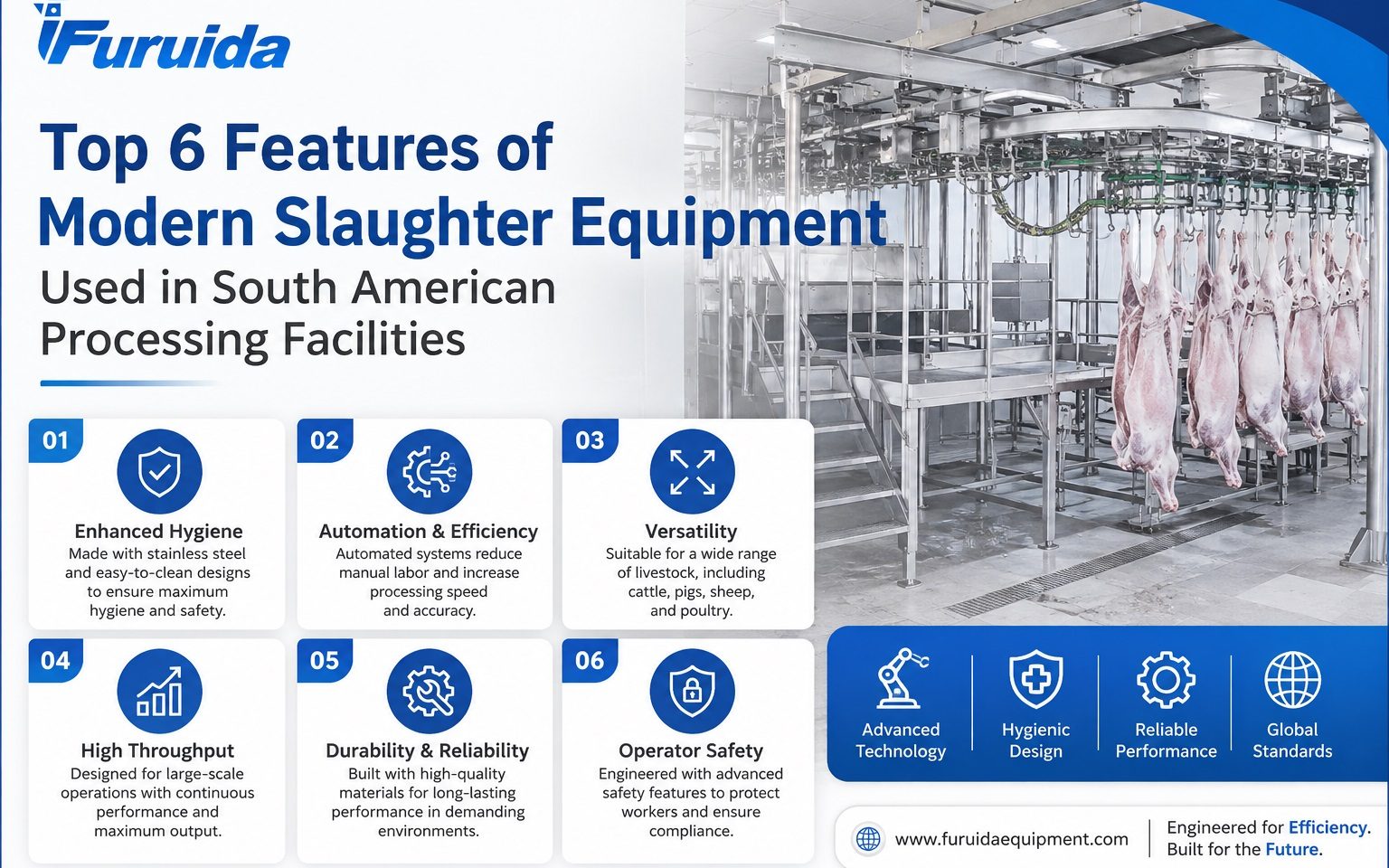
Top 6 Features of Modern Slaughter Equipment Used in South American Processing Facilities
Modern slaughter equipment is becoming increasingly important for meat processing facilities that require consistent, hygienic, and controlled production. Equipment design is now geared toward automation, processing capability, sanitary considerations, worker safety, resource utilization, and ease of maintenance.
When selecting equipment for processing plants in South America, factors such as plant size, plant requirements, available utilities, facility layout, and future expansion are also taken into consideration. The right equipment can help ensure consistency across slaughter operations and minimize unnecessary manual handling.
This guide briefly describes six key attributes of modern slaughter equipment. These include advanced automation, high-capacity processing, hygienic design, safety systems, monitoring, and flexible processing solutions.
1. Advanced Automation and Process Control
Automation is one of the most important features of modern slaughter equipment. Automated systems can reduce manual handling and can help to ensure a consistent movement from one processing stage to the next.
Automated Slaughter and Handling Systems
Automated slaughter equipment can be used to regulate animal movement and slaughtering through the use of conveyors, handling equipment, and automated processing machines. This can help to reduce repetitive manual work on the production line.
The level of automation can vary greatly. Semi-automatic machines may be used in some facilities, or constant automated processing needs may be required. The appropriate level is dependent on production volume, labor requirements, facility design, and investment plans.
Centralized Process Monitoring
Modern systems can also be connected to sensors and control devices to monitor equipment operation. Operators can follow production conditions and detect production problems more quickly by the available control systems.
Not all slaughter systems provide the same level of process control, however. It is essential for buyers to analyze the monitoring and control features of each machine before making a purchase.
2. High-Speed and High-Capacity Processing
When choosing industrial slaughter equipment, the processing capacity is another crucial factor to take into account. Equipment must be capable of handling the desired production without needless delays between processing steps.
Continuous Processing Capabilities
Continuous processing systems continuously transfer products or animals from one stage to the next. These operations can include stunning, bleeding, scalding, plucking, evisceration, washing, chilling, cutting and more depending on the use.
A well-designed line can guarantee that one stage will not unnecessarily slow the others down. This can aid in a smoother production flow for facilities.
Scalable Equipment for Different Facilities
Not all processing facilities need the same capacities. In smaller plants compact systems and semi-automatic systems can be installed, whereas larger plants may need continuous systems with a higher throughput.
Modular equipment can also allow facilities the flexibility for future expansion. The buyer should consider their current needs when selecting meat processing machinery and their future production capacity as well.
3. Improved Hygiene and Sanitation
Good hygiene is required in meat processing operations. Equipment should be configured to facilitate cleaning, sanitation, inspection, and maintenance as needed.
Hygienic Equipment Design
Generally, materials and construction methods used in modern slaughter equipment are appropriate for food-processing operations. Stainless steel is the most commonly used material in this type of equipment, as it offers a durable and cleanable surface.
When cleaning, operators will find it easier to remove residues from smooth surfaces and accessible components. The design of equipment should also reduce surface areas where material can pool.
Easy Cleaning and Sanitation
Washdown-friendly construction can make regular cleaning easier. Operators should have access to the important areas of the equipment without unnecessary disassembly.
South American buyers should ask questions about maintenance, materials, drainage, access, and sanitation when evaluating slaughter equipment. This information can impact daily operations and long-term equipment upkeep.
4. Enhanced Worker and Animal Safety
When choosing between automated and conventional slaughterhouse equipment, safety must be taken into account. Processing machinery has moving parts, electrical components, cutting tools, and other hazards.
Safer Equipment Operation
There are various measures that can be taken to minimize risks during equipment operation, such as protective guards, emergency-stop systems, and appropriate machine controls. Proper training should also be provided to the operators before operating machinery.
Safety requirements can vary according to equipment type and local regulations. Therefore, the buyer is advised to confirm the applicable requirements prior to installation and operation.
Improved Animal Handling
Another critical factor is controlled animal movement. Appropriate handling systems can help improve process organization and minimize unnecessary manual activity.
Equipment should be chosen based on the kind of animal being processed and the requirements of the facility. Handling arrangements should also facilitate good welfare practices.
5. Smart Monitoring and Data Integration
Some state-of-the-art meat processing equipment is equipped with monitoring and data collection features. These features may give operators more information regarding equipment condition and production activity.
Sensors and Real-Time Monitoring
Sensors can detect selected operating conditions to help identify potential equipment problems. Production data can also give plant teams an insight into machine use and maintenance.
The features depend on the type of equipment. Buyers shouldn’t assume that all automated systems have AI, IoT, cloud connectivity, or advanced analytics.
Integration With Plant Management Systems
Equipment may be linked to plant management or production systems to facilitate information flow where appropriate. Production tracking can enable managers to review past operating activity and plan maintenance.
Businesses should check what types of communication protocols, software interfaces, data outputs, and integration options are included before buying.
6. Flexible and Customized Processing Solutions
Processing facilities vary in production volume, product needs, facility layout, and level of automation. Flexible equipment can be especially helpful when standard configurations do not meet specific needs.
Equipment for Different Meat-Processing Requirements
Equipment needs vary across poultry, pork, beef, and other processing applications. Machines for one application may not be appropriate for another.
Processing capacity is also a factor. Equipment should be matched to the facility’s expected workload and must effectively interface with other stages in production.
Modular and Customizable Designs
Customizable solutions can include machine configuration, conveyor arrangement, processing capacity, automation level, and integration with existing equipment. A modular design can also allow for easier future upgrades.
Before ordering a customizable solution, buyers should provide manufacturers with accurate information regarding the size of the facility, production level, available utilities, processing needs, and existing machinery.
How to Choose the Right Slaughter Equipment for Your Facility
- Processing Capacity: Make sure that the equipment is capable of handling the current processing demands and is equipped with enough capacity for expansion.
- Hygiene: Take into account hygiene factors in material selection, surface design, access, drainage, and cleaning requirements.
- Level of Automation: Choice of semi-automatic or automatic machines depending on production quantities, requirement of working labor, and budgeting.
- Safety Measures: Verify that guards, controls, emergency shut-off, and access for operators are available prior to machine operation.
- Maintenance Needs: Consider component access, availability of spare parts, maintenance procedures, and technical assistance.
- Compatibility: Check to ensure that the equipment can fit into the building and process equipment, when necessary.
- After-Sales Services: Consider installation services, operator training, technical assistance, documentation, and availability of parts.
Conclusion
Modern slaughter equipment integrates a number of key characteristics, such as automation, high processing capacity, hygienic design, safety features, monitoring, rational resource utilization, and flexibility. These features can work together to facilitate more consistent and controlled processing operations.
In South America, processing equipment must be assessed based on production capacity, sanitary and safety requirements, water and energy usage, maintenance needs, facility design, and future expansion considerations. A detailed evaluation can help buyers identify equipment that is suitable for their specific operations.
Are you looking for reliable poultry slaughter equipment? Nanjing Furuida Equipment Co., Ltd. provides various poultry slaughter and meat-processing equipment solutions, such as a 500 BPH chicken slaughtering line for different requirements of slaughter plants.
FAQs
What is modern slaughter equipment?
Modern slaughter equipment refers to the animal handling, slaughtering, processing, cleaning, and other supporting equipment used in slaughter plants.
What are the benefits of automated slaughter equipment?
There are a variety of benefits to automated slaughter equipment, such as reducing repetitive manual tasks, improving the consistency of processing, providing controlled slaughter flows, and increasing efficiency.
How do I choose slaughter equipment for a processing facility?
When purchasing, consider processing ability, cleanliness, automaticity, safety, repair, customizability, layout, spare parts, and after-sales technical support.
Is Nanjing Furuida Equipment Co., Ltd. suitable for slaughter equipment requirements?
Nanjing Furuida states that it supplies poultry slaughter and meat-processing equipment. The specific equipment, specifications, and features should be compared to the requirements of the buyer’s project.