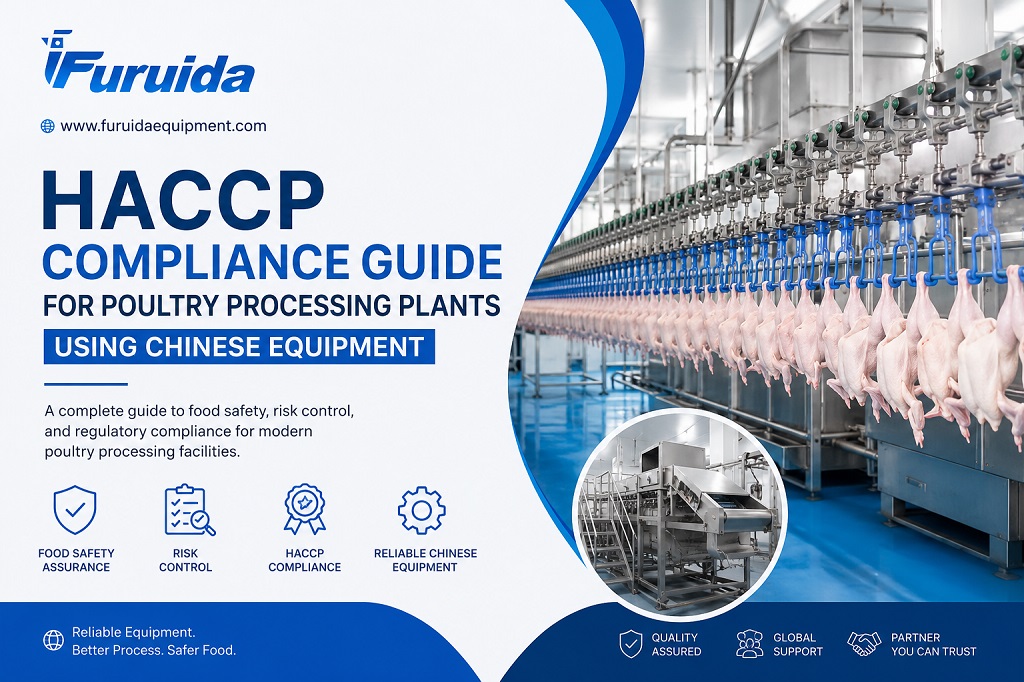
HACCP compliance guide for poultry processing plants using Chinese equipment
There’s a difference between passing a food safety audit and genuinely running a compliant operation – and most plant managers know it. HACCP (Hazard Analysis Critical Control Point) isn’t a checklist you complete once a year. It’s a living system that has to work on your floor, with your equipment, every single shift. And when your poultry processing plants are equipped with Chinese-manufactured machinery, there’s an extra layer of complexity that rarely gets addressed in standard compliance guides. This isn’t about distrust of Chinese equipment. Some of the most capable, well-engineered poultry processing lines in the world come out of Chinese manufacturers. This is about understanding where compliance gaps commonly appear – and how to close them before an auditor or an importing country does it for you.
What HACCP Really Needs from Your Equipment.
The compliance of HACCP in poultry processing plants is not only related to what you do there but also to the design and the state of your equipment. The seven HACCP principles require you to identify the hazards, define critical control points (CCPs), and ensure that the controls you are using are actually in place. All that is in your equipment. When a scalding tank is unable to maintain a constant temperature, your CCP to reduce pathogens is invalid. When a defeathering machine has areas that entrap organic matter, then your sanitation records are worth nothing.
The most common areas of equipment-related compliance failures are:
- Temperature regulation – Scalders, chillers, and cook systems that vary out of range between documented values.
- Risk of cross-contamination – Surfaces, joints, and moving parts that store blood, fat, or tissue between cleaning periods.
- Traceability lapses – Equipment that does not link to your lot tracking or monitoring networks.
The first step to any serious food safety compliance effort is to know where your equipment is on each of these.
Key HACCP Critical Control Points (CCPs)
Each processing step is risky. Determining CCPs is vital to any poultry processing facility.
The most important are the following ones:
- Scalding: Temperature should be checked to avoid survival of bacteria.
- Defeathering: The hygiene of equipment is essential.
- Evisceration: Risk of contamination is high unless it is done correctly.
- Chilling: Slows down the growth of bacteria by rapid cooling.
All these stages are to be tracked and recorded.
Where Chinese Equipment Creates Specific Compliance Considerations
Over the last ten years, Chinese poultry processing equipment has improved significantly. The modern manufacturers are constructed to CE and ISO and, in few instances, to USDA-compatible standards. However, compliance considerations are still a concern processors must take an active role in.
Documentation and certification alignment: Equipment that is sold into foreign markets must be accompanied by documentation that will be accepted by your importing country’s food authority. This implies CE marking in Europe; North American certification of NSF, where it is required; and material certificates of food-grade stainless steel grades. These are not available from all Chinese manufacturers. When you are buying, ask immediately. In case you have already purchased, audit what you have.
Spare parts and maintenance traceability: HACCP mandates that you can prove that equipment is maintained and operating properly at each CCP. When spares are obtained without record keeping, or maintenance is not recorded with equipment IDs, you have a traceability gap. This is not specific to Chinese equipment but is more prevalent when the supply chain is less formalized.
Language and training issues: Most Chinese-made machines will include manuals and calibration directions in Mandarin with variable-quality English translations. Those operators who are not well aware of the procedure of calibration can be unaware of letting CCPs drift. Obtaining localized and correct documentation is not optional but a requirement as per the compliance.
Choosing the Right Equipment Partner
Your supplier is a key determinant of the smoothness of your compliance journey. Even the most excellent systems may not work without the correct guidance and support of the manufacturer. That is why poultry processing plants should not only focus on price comparison but also look at the long-term reliability.
When comparing equipment suppliers, consider:
Real industry experience: An experienced supplier that has practical experience of real project work knows where compliance is an issue and how to find a solution.
Custom HACCP-friendly designs: The equipment must be designed to suit your workflow and make hygiene and monitoring simpler.
Strong after-sales services: Fast service, availability of spare parts, and technical assistance minimize downtime and stress.
Picking the appropriate partner is not a purchase choice but a strategic choice. A proper support system is used to make sure that poultry processing plants remain compliant, minimize risks, and run with confidence on a daily basis.
Conclusion
HACCP is not just about inspection runs; it is about developing trust, getting contracts, and growing your business. In the case of the modern poultry processing plant, compliance needs to be incorporated in every process and machine. Furuida Equipment provides reputable, HACCP-prepared solutions to poultry processing plants that are based on Chinese equipment. Modernize your workflows with smart, compliant, and efficient systems that will ensure success over time.
FAQs
Does the Chinese equipment comply with the HACCP standards?
No, Chinese equipment cannot be used to comply with HACCP standards, but it can when it is installed correctly, maintained correctly, and set in accordance with your HACCP plan.
Which is the most crucial CCP in poultry processing?
The most critical control points are usually evisceration and chilling because there is a high risk of contamination. All poultry processing plants should have proper handling, temperature control, and sanitation in these stages.
What are the frequency of updating HACCP records?
The records of HACCP are to be updated on a daily basis, and the critical control points are to be monitored in reality. Regular and proper record keeping is essential to both audit and long-term compliance in poultry processing plants.
Do small poultry processing plants need HACCP?
Yes, all poultry processing facilities, big or small, are required to be under HACCP. These rules have to be adhered to even in small operations to guarantee food safety and compliance with the regulations.