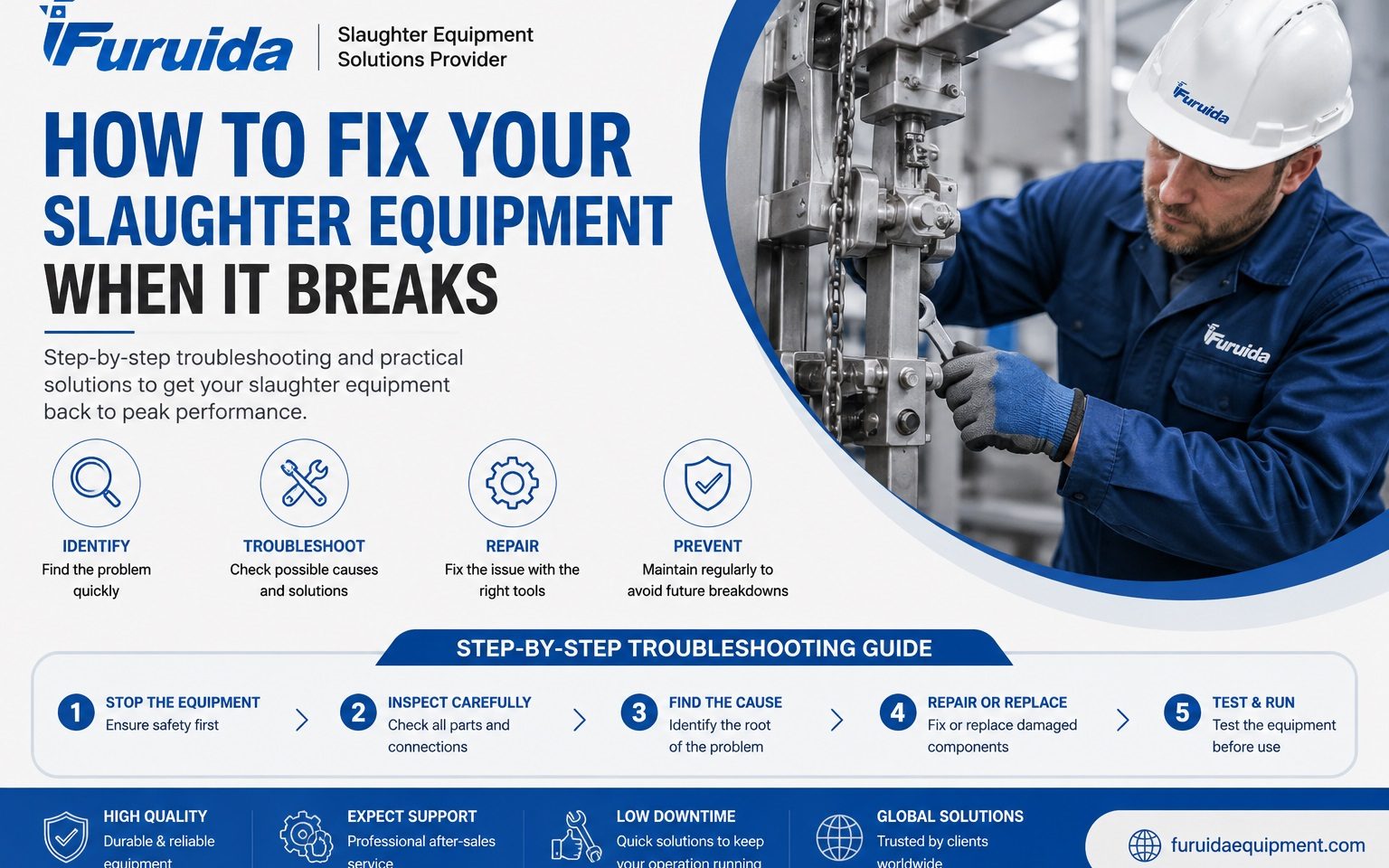
How to fix your slaughter equipment when it breaks
Every plant manager’s worst moment is a slaughterline breakdown. Production stops. Costs spike. Then your team is left scratching their heads under pressure with the clock ticking. The reality is that slaughter equipment is used in extreme conditions every day: heat, moisture, and mechanical stress. Failures are inevitable. With knowledge, most can be quickly resolved and prevented from repeating. This guide covers the most frequently occurring problems with slaughter equipment and how to handle them.
Why Slaughter Equipment Fails
Most breakdowns are not random. They are following a pattern. At most meat processing plants, problems stem from three common issues: inadequate daily cleaning, which leads to corrosive residue accumulating; deferred maintenance, where minor problems are ignored and allowed to multiply; and the use of non-OEM parts that wear too quickly.
These small operational mistakes over time put constant stress on slaughter equipment and reduce overall system reliability. A small maintenance issue can soon become costly downtime, decreased processing efficiency and surprise repair costs.
How to Fix the Most Common Slaughter Equipment Failures
Major equipment failures usually begin with minor problems that are easily ignored. A slight decrease in performance, unusual vibration, irregular cuts or conveyor lag can escalate quickly into serious production problems if not addressed.
1. Captive Bolt Stunner Not Performing
Weak bolt velocity or complete failure puts animal welfare compliance at immediate risk. This is a zero-tolerance issue on any slaughter line.
Start by inspecting the barrel for carbon buildup and clean it thoroughly with a bore brush. Check that the correct cartridge load is being used wrong loads are a surprisingly common cause of weak strikes. Inspect the trigger mechanism and replace worn springs or pins. A calibrated spare stunner should always be on standby. Stunning equipment cannot go down without an immediate backup ready.
2. Overhead Rail and Conveyor Issues
When trolleys jam or rails misalign, the entire line backs up within minutes. Check for bent or warped rail sections, which are usually caused by overloading. Inspect trolley wheels and bearings for flat spots or corrosion. Insufficient lubrication is one of the most common causes of binding – re-lubricate with food-grade lubricant and check drive motor connections and chain tension. Never try to reshape a bent rail section on-site. Replace it.
3. Skinning Machine Failures
Here, the primary causes of blade dullness, hydraulic problems, and roller wear come into play. Test the sharpness of blades first – dull blades put an excessive strain on the motor and yield uneven hides. Check hoses and hydraulic fluid levels for leaks. Inspect roller pressures and look for abnormal vibration, which is typically an indicator of bearing failure. It is far more cost-effective to take out blades on a regular basis than to wait until they fail.
4. Evisceration Tool Problems
Evisceration tools work in the harshest environment on the line. Pneumatic tools often lose pressure due to air leaks at fittings. Blade assemblies jam from fat and tissue buildup inside the housing. Trigger mechanisms stick without regular lubrication. Daily disassembly, cleaning, and sterilization are the only ways to keep these tools reliable shift after shift.
5. Scald Tank Temperature Inconsistency
A non-uniform scald tank is not only a problem for the quality of the product but also for the hygiene standards in pork processing plants. Verify heating element function first. Check tank agitators for motor or wear and ensure timer controls are set correctly. A faulty heating element is a straightforward fix, but running with inconsistent temperatures is not an option.
Quick Repair Reference
| Equipment | Common Failure | First Action |
| Captive Bolt Stunner | Weak bolt / no fire | Clean the barrel and check cartridge load |
| Overhead Rail | Trolley jamming | Lubricate and replace bent rail section |
| Skinning Machine | Inconsistent hide removal | Check blades and hydraulic fluid |
| Evisceration Tool | Pressure loss / jamming | Check air fittings, disassemble and clean |
| Scald Tank | Temperature fluctuation | Test the heating element and calibrate the timer. |
Prevention Is Cheaper Than Every Repair
Reactive repairs maintain your line. It continues to be profitable when maintained preventively. Wipe down all contact surfaces every day, lubricate moving parts and check the edges of blades at the beginning of each shift. Weekly, check hydraulic fluid levels and test stunner calibration. Complete a monthly mechanical check and change out wear items before they fail. Review parts inventory and provide refresher staff training quarterly.
Document everything. Over time, patterns are seen in data – and patterns let you know what will fail before it fails.
Repair or Replace? Here Is How to Decide
Not all breakdowns should be fixed. When repairs are more than 50% of the current market value of the equipment or the same part has failed more than twice within 12 months, replacement is a better financial decision. The same applies when spare parts to older machinery are becoming difficult to obtain. Downtown is not an option for an eight-hour-a-day processing plant.
Conclusion
When slaughter equipment fails, it disrupts the operation – it’s manageable, but only if you know what to expect and how to react. Know your tools and equipment failure modes and take decisive action when something fails. Develop a maintenance plan that identifies and prevents problems before they cost you a full shift.
Looking for dependable slaughter equipment, authentic replacement parts or professional technical advice? Then Furuida Equipment is the great solution you’ve been searching for. They know what’s required to run a commercial meat processing facility and can assist you in reducing downtime and maximizing the production capacity of your line.
FAQs
What is the most common cause of slaughter equipment failure?
The majority of failures are due to poor cleaning, poor maintenance and OEM parts. All three issues are directly tackled by a structured preventive maintenance schedule.
How do I reduce downtime on my meat processing line?
Ensure that the necessary spares are kept on site, have a daily and weekly maintenance plan, and train employees to look for signs of trouble before a complete system failure takes place.
How often should slaughter equipment be serviced?
Cleaning and lubrication are essential every day. More in-depth mechanical check-ups are to be conducted every week and month, and a full equipment audit is to be conducted quarterly.