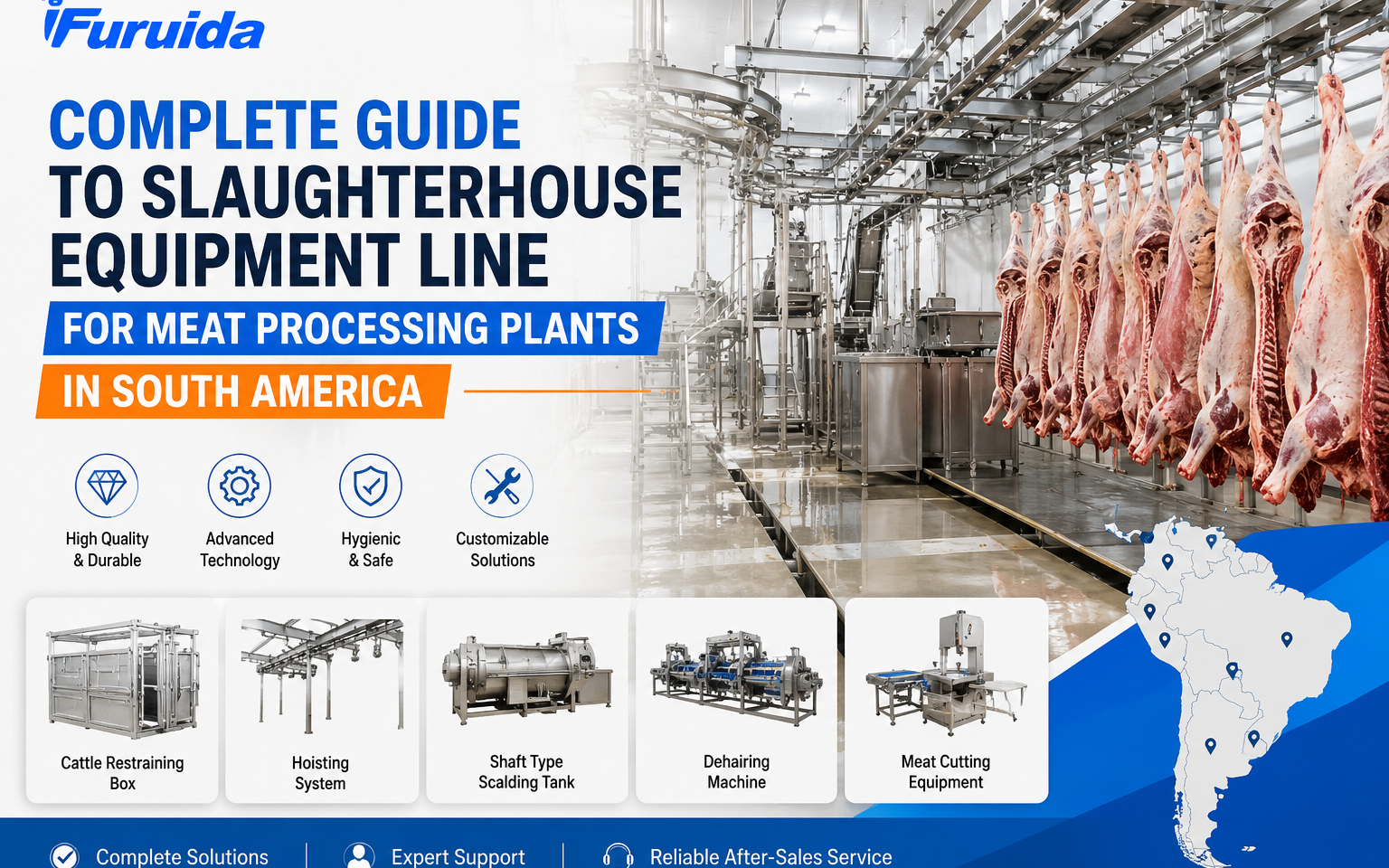
Complete Guide to Slaughterhouse Equipment Line for Meat Processing Plants in South America
The export of meat from Brazil, Argentina, Paraguay, and Uruguay has grown markedly during the last decade, forcing processing plants throughout the region to modernize at unprecedented rates. The very core of that modernization is one decision that drives all other decisions: the design of the slaughterhouse equipment line itself. The equipment line is where a plant ultimately achieves EU export certification, grows to satisfy Asian demand, or simply aims to reduce labor expenses.
This guide is designed for plant owners, procurement managers, and investors considering a new build or retrofit in South America. It explains what an equipment line is, the essential stages that every plant should be equipped with, the differences between South America and North America or Europe, and how to select slaughter equipment that meets budget and compliance requirements. At the end of the process, you should have a clear idea of how to assess any slaughterhouse machine supplier or turnkey offer and the terminology to use when comparing quotes from various vendors on a like-for-like basis.
Think of this as your pre-sourcing roadmap — a map of the entire Slaughter Machine Line, not just one station on it.
What Is a Slaughterhouse Equipment Line?
A slaughterhouse equipment line is the complete chain of linked machines that transports an animal from the live receiving area to a dispatched carcass or cut. It is not just one slaughter machine line running end to end, and it is not a bunch of separate machines that have been put together at the end. It is an engineered system, with the output of the stage determining the output of all subsequent stages.
Most plants divide the line into two sections: the unclean side (or “dirty” side) and the clean side. The unclean line encompasses the stunning, bleeding, skinning, and defeathering of animals and evisceration/gut jobs. The clean line becomes active after the evisceration, which includes carcass splitting, chilling, cutting, and packaging. Physically and operationally separating these areas is a hygiene requirement in almost all export markets and can have a direct impact on overall plant layout, from the location of staff changing rooms to the placement of equipment washdown stations in relation to each conveyor run.
The real-world productivity and yield of a plant are determined more than anything else by the line design, not any specific piece of slaughter equipment. Two plants can have the same core equipment but have wildly different output numbers due to conveyor speed differences, chilling bottlenecks, or lack of sequencing between the unclean and clean sides. Even when every other machine in the plant is running at full capacity; a single under-capacity slaughtering machine, such as an evisceration machine, can quietly cap overall plant output.
Understanding the line as a system, not a shopping list, is the first step to sourcing it correctly. It implies assessing rated line speed, footprint, utility needs, and hygiene zoning as a whole, not just taking individual machines on a price basis and hoping to get them to fit together when they get to your site.
Core Stages of the Equipment Line
All slaughterhouse equipment lines, regardless of species, pass through the same general sequence. The individual machines vary for cattle, hogs, and poultry, but the rationale for the line remains the same from receiving to packaging.
Stunning & Restraint Systems
The most regulated station by animal welfare legislation in all export markets is the stunning station, and it tends to be the first station on any slaughter machine line. Cattle plants generally employ pneumatic stunners or captive bolt stunners in a restraint box, while hog operations may use CO₂ stunning tunnels that are designed to process pigs in groups instead of one at a time. Electrical stunning is still frequently used for both hogs and poultry, and voltage and duration of exposure are adjusted by species and certifying body inspecting the plant.
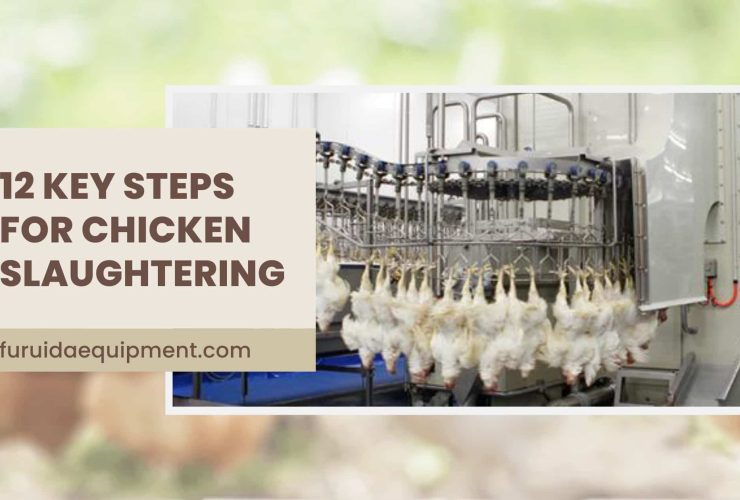
For poultry lines, at this stage, poultry slaughtering equipment typically consists of a multi-bird electrical water-bath stunner installed directly into the shackle line, which stuns the birds without any manual handling from the operator. Stunning and restraint are not only welfare issues—they have an impact on meat quality downstream, as poor stunning results in high levels of blood splash and bruising, which are not detected in the line until later, causing yield loss.
Restraint box design also impacts the safety of workers and stress on the animals, and these effects are assessed by auditors from SENASA, MAPA, and international certification bodies firsthand during plant inspection. This well-specified slaughter equipment package minimizes struggle time, thereby reducing the related meat quality issues caused by cortisol at this station, which are becoming a critical part of export buyer testing.
Bleeding & Hoisting
Once stunned, an animal is lifted onto an overhead rail by means of the shackles, and the bleeding process begins. Bleed duration and rail speed have to be matched carefully; if the rail moves too fast, incomplete bleed-out affects shelf life and appearance; if the rail moves too slow, the line backs up at every station behind it. Bleed rails are often enclosed or placed so that there is no splashing of blood onto the clean side of a plant, and floor drainage design is a common audit element for both SENASA and USDA inspection of export-grade plants.
Hygiene at this stage also depends on shackle sanitation. Many modern lines feature automated shackle washers located at the overhead conveyor return point, reducing the workload of manual cleaners, which are still at work in many small domestic lines. Rail geometry is important as well; sharp turns or varying inclines may lead to swinging or collision of carcasses, which results in bruising that is visible as trim loss in the cutting room.
Skinning/Defeathering & Evisceration
This is where the differences between species are most important. Hide pullers or dehiding machines are used on cattle and hog lines to pull the hides down, and rotating rubber-finger pluckers remove feathers after scalding, ahead of evisceration. Evisceration has become almost fully mechanized in large export plants, with the introduction of rotary evisceration machines, which remove viscera in a single motion without the need for a cut-and-pull team.
Evisceration line speed is typically the most significant limitation on overall plant capacity, particularly for processors considering this specific piece of poultry slaughtering equipment, as it is crucial to ensure exact timing of the various operations on the evisceration line to prevent contamination of the product between the guts and the carcass. The temperature of the scald tank and the time the bird spends in the tank should also be closely monitored, because both have an impact on how easily the feathers can be removed without compromising the quality of the skins — something that export buyers rely on as heavily as on weight.
Carcass Splitting & Grading
After cleaning, cattle and hog carcasses are fed into splitting (usually a vertical band saw that cuts the carcass in half along the spine). Many large plants now have automated grading systems, capturing images via camera vision or ultrasound probes immediately after splitting to classify carcass fat cover, muscle yield, and weight before the carcass ever reaches a human grader. This is one of the most obvious areas where a modern slaughterhouse machine’s return on investment can be tied directly to the grading of the animals, as it directly influences the price a plant could charge per animal head. Splitting saw calibration matters just as much as the grading technology downstream, because an off-center cut results in the loss of usable meat on both halves and can cause rework that slows the entire clean side line.
Chilling & Cold Storage
Chilling is where a plant either preserves or undoes all the work invested across the rest of the line. The fast chill rate obtained in quick chill tunnels helps to control the growth of bacteria and to reduce drip loss, which is the moisture loss a carcass undergoes as it cools. Often in warmer areas of South America, chilling capacity is the restricting factor that can significantly reduce per-shift processing capacity of a plant because of the increased difficulties that ambient heat load causes for the refrigeration system achieving target chilling temperatures in a timely fashion.
Cutting, Deboning & Trimming Lines
Once chilled, the carcasses are processed into the large sub-sections (loin, rib, chuck, etc.) that ultimately become retail or export cuts. Deboning can be automated by robotic arms controlled by either X-ray or vision systems or be done manually on gravity-fed tables — depending on the cost of labor, the consistency of the product, and the capital to invest in a more advanced slaughtering machine setup. Many plants in South America operate hybrid systems, which means that they automate their primal cuts but retain manual trim tables for specialized or export cuts that need some closer attention.
Packaging & Logistics Integration
This is the last step that brings the cutting room into case-ready packaging and internal conveyance. In export-grade plants, vacuum sealing, modified-atmosphere packaging, and automatic case erectors are becoming commonplace, as packaging security is inspected at customs in markets such as the EU and China. Internal transport – conveyors, overhead trolleys, and cold-chain staging areas – also must be sized to match the throughput of all upstream activities, or the packaging room is the new bottleneck even after the rest of the slaughterhouse equipment line is upgraded.
South America Market Context
South America is one of the few regions in the world increasing its meat exports year over year, and this trend shapes how plants across the region source equipment.
Brazil and Argentina continue to lead the world in beef exports, with Brazil also ranking among the top global poultry exporters, and Paraguay and Uruguay are significant beef and poultry exporters despite the relatively small size of their domestic populations. Brazil has developed its own large-scale poultry export capacity in the last 20 years, and this size has attracted large multinational equipment manufacturers to establish local sales and spare parts storage and installation teams, which sometimes are not possible in smaller markets because they have to rely on regional distributors. That export orientation is important, as it means that a significant proportion of regional plants are constructed or upgraded to export buyer requirements – typically European, Chinese, or Middle Eastern – and not just domestic. The layout and documentation system are much different for a plant seeking EU certification than for a plant that only sells within its own country.
The other determining factor is labor cost. Many areas of the region are still relatively cheap for labor, altering the factors for automation as compared to North America or Western Europe. Manual work remains the preferred method in many mid-sized plants, particularly for tasks such as trimming and deboning; tasks such as evisceration and grading, where consistency and speed are still important aspects for export certification, are where capital is dedicated to automation. Larger export-grade operations, on the other hand, are becoming more and more automated, as foreign buyers are often demanding the same level of traceability and uniformity that is available with automated lines.
Climate and infrastructure add another layer. In many parts of Brazil, Paraguay, and northern Argentina, the heat load places significant stress on chilling and cold storage systems, while in other less developed regions, plants may face difficulties in accessing water when required or in the reliability of grid power, which affects the choice of backup generation and water recycling systems integrated into the equipment line.
The market is therefore divided into two types of plants: large, highly automated export-oriented ones, competing on international certification; and smaller domestic or regional plants, which rely mainly on labor and simpler equipment and are subsequently upgraded as export aspirations increase. The most important filter to use when narrowing down slaughter equipment suppliers is to understand which profile your plant belongs to or you want to become, because suppliers will specialize in one side or the other.
Choosing the Right Equipment Line for Your Plant
Selecting a slaughterhouse equipment line starts with an honest capacity plan. Typically, line speed is measured by the number of animals processed per hour, which should be based on realistic demand projections, not wishful thinking, as undersizing will limit growth before a plant even opens, and oversizing will incur unnecessary capital costs. It also helps to plan capacity in stages: many successful plants have sized the building and utilities for the 5-year target throughput and installed equipment for the near-term capacity with room for expansion without facility rebuild.
For new builds and retrofits, different sourcing approaches can be used. A new build enables a plant to control layout to ensure that the unclean and clean sides are separated cleanly from the outset. A retrofit must also work around an existing structure, and with that comes the question of which station to upgrade first; the most often limiting factors are evisceration and chilling, so those tend to be the first upgrades to be completed.
There are a lot of different budget tiers. Entry-level lines, which are based on simpler, mostly manual slaughter equipment, are significantly less expensive initially but have higher monthly labor costs and lower profitability on export certification. Middle-tier lines feature a combination of automation at stations that are key bottlenecks and manual work at others. Highly automated, full turnkey lines are the most expensive to install initially but generally the most rapid to pay back for plants aimed at high-volume export contracts due to the lower operator cost per tonne and the reduced risk of any hygiene issues that could result in export certificates being suspended.
In the case of dealing with manufacturers, plants are generally operating in one of three ways: purchasing individual OEM machines and adding them on to existing systems without assistance; commissioning a custom line that is designed around their plant layout; and contracting a turnkey provider to design, install, and commission the entire slaughter machine line as a single project. For plants that lack engineering resources to oversee a multi-vendor installation, turnkey providers carry a premium but also significantly decrease the integration risk. No matter which route you take, you should consult suppliers to ask about reference installations at comparable throughput in similar climates – a slaughterhouse machine that’s running smoothly in a temperate European plant doesn’t necessarily perform the same way in a hot, humid South American facility.
Compliance & Export Standards
In South America, export-grade plants are subject to more than one regulatory authority, and equipment decisions must meet the requirements of all of them.
Domestically, Argentina’s SENASA and Brazil’s MAPA establish the minimum sanitation and inspection requirements to which all plants must adhere in order to be legally allowed to operate. Most plants also must meet the requirements of the country to which they are exporting, such as the USDA equivalency requirements for the U.S. market, EU health certification requirements for European buyers, and more and more stringent documentation standards for the importers from China and other Middle Eastern nations. These standards are not always fully compatible, and an equipment line layout approved for one export market may require modification to meet another market.
Nearly all of the above-mentioned stages of the line encompass hygiene design requirements. While inspectors are checking plant policy documents, they are also checking the following against equipment specifications: physical separation of unclean and clean areas; non-porous surfaces that are easily sanitized; adequate floor drainage; and water temperature controls at wash stations.
The importance of traceability has become as significant as that of physical hygiene design. Modern slaughtering machine installations are often specified with built-in software, including systems that tag each animal or each lot at various points in the process from stunning to final packaging, as well as systems that are able to capture weight and grade information and that have the capacity to link equipment-level data directly to food safety and export documentation. Plants that incorporate this into a line’s original equipment specification are spared the much more costly process of retrofitting traceability systems onto a line that wasn’t designed to integrate one. When making a purchase, it is good practice to ask at an early stage if a particular slaughter machine line is supplied with open data protocols or a proprietary system, as this will determine how easily the line can interface with any particular plant’s compliance software package.
Automation & Future Trends
Robotics is making steady progress at stations that were purely manual just a few years ago. The use of vision-guided robotic arms to follow the shape of each carcass to make the cutting paths is now gaining traction, especially in the deboning and dressing lines, and is helping to reduce the level of inconsistency that used to be found in manual lines compared to automated ones.
Software integration is following the same trajectory. Whereas before, traceability systems, yield tracking dashboards, and predictive maintenance applications integrated directly into a slaughterhouse equipment line were seen as optional extras, they are now expected as standard – they provide plant managers with instant visibility into yield loss and service needs for stations before a breakdown occurs.
The pressure of sustainability is also impacting equipment specifications. Water recycling systems, energy-efficient refrigeration for chilling tunnels, and heat-recovery systems on scalding tanks are becoming more popular requests from regulators and export buyers, who are also pressured to provide reports on supply-chain sustainability. If you’re planning a new line purchase for your plant in South America in the coming few years, these three trends are going to make the difference between staying competitive and getting left behind as export buyers set a new standard on what a modern slaughterhouse equipment line should contain.
Conclusion
The performance of any slaughterhouse equipment line is determined by its weakest link, so owners and procurement managers often achieve optimal performance when they look at the plant equipment as a system instead of a series of individual machines. But from stunning through packaging, the throughput, yield, and compliance performance of any station directly affect those same outcomes at every station that follows — and in South America’s rapidly expanding export business, that connectivity is in fact making a difference between plants that win international buyers and plants that do not.
If you are thinking about a new build or retrofit, the first step is to identify your bottlenecks and compare them to the stages mentioned in this guide, then investigate further in the stations that are most relevant to your plant. Check out our related guide to cattle stunning systems for more details on restraint and stunning technologies, or get tips on selecting the right equipment manufacturer in South America by reading How to Choose an Equipment Manufacturer in South America.
FAQs
1. What is a Slaughterhouse Equipment Line?
It’s the complete integrated system of machinery — from stunning to packaging — that processes an animal from live receiving to dispatch-ready product. It includes both the unclean (dirty) and clean sides of the operation.
2. What’s the difference between slaughter equipment and poultry slaughtering equipment?
General slaughter equipment covers machinery used for livestock such as cattle and hogs, while poultry slaughtering equipment refers to species-specific machinery such as scalding, defeathering, and water-bath stunning systems designed for birds.
3. How much does a slaughterhouse machine setup cost for an export-grade plant?
The costs differ significantly depending on the level of automation, with the highest price for export-quality lines, which include advanced grading, chilling, and traceability facilities. Budget and ROI should be based on your specific target export market.
4. Do South American plants need special certification for their slaughter machine line?
Yes — depending on the export market, plants should comply with USDA, EU, or national body requirements such as SENASA (Argentina/Paraguay) or MAPA (Brazil) standards as well as with hygiene design requirements integrated into the line.